


Nearly nine in ten marketers now lean on AI to help them write. The moment you do, a new worry creeps in. What if a detector flags your work as fake? Maybe it already has on something you wrote yourself.
I have spent over ten years writing, editing, and running SEO and now GEO content for brands, so I have leaned on these detectors and been burned by them more than most.
That fear is real, and so are the stakes, from a lost client to a cheating accusation you did not earn. So I tested eight of the most popular AI detectors, running each through genuine human writing, pure AI writing, and the hybrids in between.
I judged each AI detector on the one thing that actually matters — catching AI without punishing real people.
My findings? The short answer is the tool you need depends on you, and the score matters far less than you have been told.
TL;DR: Which AI detector should you use?
Pressed for time? Here is where the testing landed.
If you must pick one, Pangram was the most accurate overall. It caught the AI writing and mostly left the human writing alone, though no detector here is reliable enough to trust on its own.
Best free is QuillBot. If your real worry is being wrongly flagged, Copyleaks stayed cleanest on genuine human text. For the classroom, GPTZero is the one built for academic use.
Keep one line in mind as you read. The best detector is not the one that shouts AI the loudest. It is the one that rarely flags your real writing by mistake.
Best AI detectors compared at a glance
Here are all the tools I tested, side by side. Read the false-positive column first.
It tells you whether a detector can be trusted around your own writing, and it is the column most roundups skip. A high detection score means little if the same tool also flags genuine human work.
| Tool | Human sample | AI sample | False-positive risk | Price | Best for |
|---|---|---|---|---|---|
| PangramMost accurate (imperfect) | 98% human | 99% AI | Low | $20/mo · 7-day trial | Accuracy on both sides |
| CopyleaksSafest + plagiarism | 97% human | 98% AI | Low | $13.99/mo | Avoiding false flags |
| Winston AIBest all-rounder | 96% human | 97% AI | Low | from $10/mo | Everyday use |
| GPTZeroBest for educators | 99% human | 72% AI (cautious) | Low | $12.99/mo | Schools |
| QuillBotBest free | 91% human | 93% AI | Low–med | free · $8/mo | Free everyday checks |
| Originality.aiPowerful but aggressive | 68% AI (false positive) | 100% AI | High | $12.95/mo | High-volume screening |
| TurnitinInstitutional only | not testable | not testable | Reported high | institution only | Schools already on it |
| ZeroGPTQuick free check | 31% AI | 58% AI | Medium | free + paid | A fast second opinion |
Every detector scored on the same human and AI writing samples. Tap a tool to jump to its full review.
How I tested these AI detectors
Before you trust any ranking, you should know how it was built. Here is mine.
I ran the same samples through every tool and judged them on two questions. Can it catch AI writing, and can it leave real human writing alone? The second question decided the rankings.
Each tool saw four kinds of text. The first was genuine human writing, including a piece I wrote before 2022, so there is no argument about who wrote it. The second was pure AI output from a current model.
The third was a hybrid draft, part human and part AI, the way most people actually write now. The fourth was AI text run through a humanizer, since that is what people do to dodge detection.
I tested short and long passages and writing from both native and non-native English speakers because that is where detectors tend to break down. For every tool, I recorded what it said about the human writing, not just how well it caught the machine.
The 8 best AI detectors, reviewed
Here are the eight tools, ranked by how well they balanced catching AI with sparing real writing. Each entry covers accuracy, false positives, price, and who it suits best.
Pangram: the most accurate, but not perfect
Pangram came closest to getting both halves of the job right.
How accurate is it?
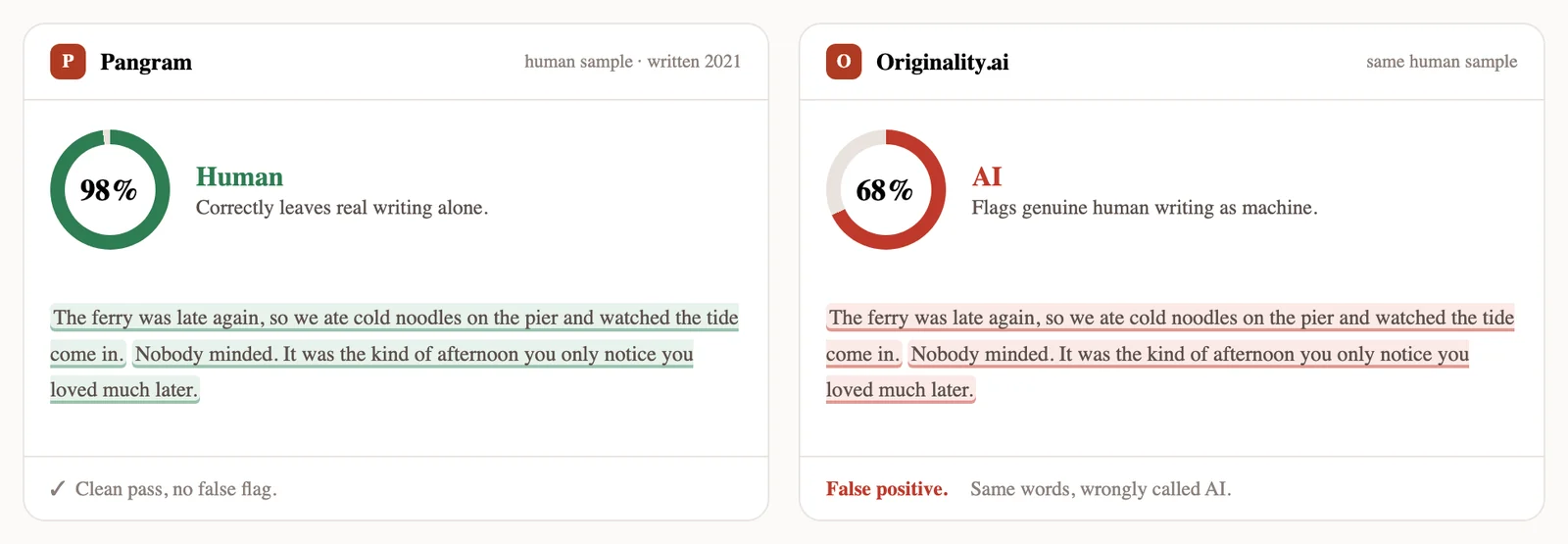
On my human sample, it returned 98% human, and on the AI version, it returned 99% AI. That clean split is rarer than it sounds. Plenty of tools can spot obvious machine text, but far fewer manage it without getting jumpy about real writing.
Will it flag your real writing?
This is where Pangram came closest. It stayed calm on genuine human text, including the piece I wrote years ago, and it did not manufacture suspicion where there was none. It also shows sentence-level reasoning, so you can see why it landed where it did.
What does it cost?
Pangram offers a 7-day free trial, and paid plans start at $20 a month.
Who it's best for
If you are going to lean on one tool, this is the one I would reach for. Even then, pair it with a second opinion rather than treating its score as proof.
Copyleaks: safest, and it checks plagiarism too
Copyleaks matched Pangram on the numbers that matter, then added a second job on top.
How accurate is it?
My human sample came back clean at 97% human, and the AI sample came back 98% AI. You get a decisive call in both directions, without the false alarms that sink lesser tools.
Will it flag your real writing?
No, for the most part, and that is the point. It left my genuine writing alone while still committing to a firm answer on the machine text. That balance is what makes it safe to use around people whose reputations are on the line.
What does it cost?
There is a free trial, and paid plans start at $13.99 a month billed annually. Some of the richer sentence-level detail sits behind that paywall.
Who it's best for
Teachers, editors, and agencies. Copyleaks grew up as a plagiarism checker, so if you also need to catch copied text or you work through a system like Canvas, it combines both checks into a single workflow.
Winston AI: best all-rounder
Winston AI was the most pleasant to actually use, and its accuracy backs up the polish.
How accurate is it?
It scored my human sample at 96% human and the AI version at 97% AI. Not the near-perfect split between the top two, but close enough that you can rely on it day to day.
Will it flag your real writing?
It behaved well on real text, and it makes its thinking visible. You get an AI prediction map and sentence highlights showing where the suspicion sits, instead of one flat number you have to take on faith. When you can see the reasoning, you are less likely to over-trust it.
What does it cost?
Paid plans start at $10 a month after a free trial, and it bundles extras like image detection and plagiarism checks.
Who it's best for
People who want one practical tool for everyday use. If Pangram and Copyleaks are the specialists, Winston is the reliable generalist.
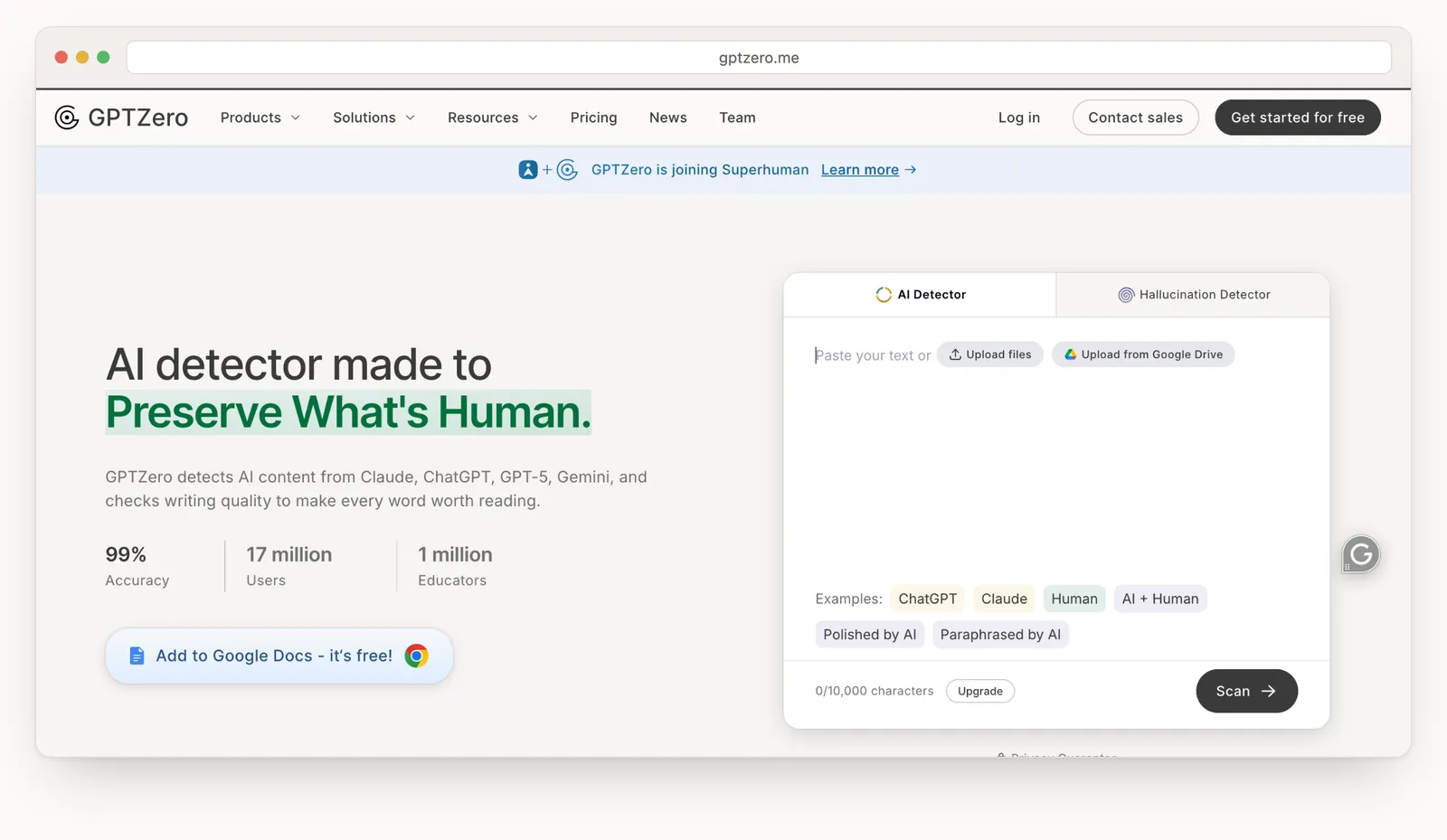
GPTZero: best for educators
GPTZero is the name you have probably already heard, especially if you spend any time near schools.
How accurate is it?
On my human sample, it returned a confident 99% human. On the AI sample, it was deliberately cautious, landing around 72% AI with a mixed verdict rather than shouting a hard call.
Will it flag your real writing?
Rarely, and that caution is a feature here. If your worst outcome is falsely accusing a student, a detector that hesitates before making a hard call protects you from the mistake that can end careers.
Some people find the hedging frustrating, but in a classroom it is the right instinct.
What does it cost?
There is a free tier, and paid plans start at $12.99 a month. A little of the sentence-level detail sits behind the paywall.
Who it's best for
Educators, and anyone who would rather under-accuse than over-accuse. It is built for the academic world, and it behaves like it.
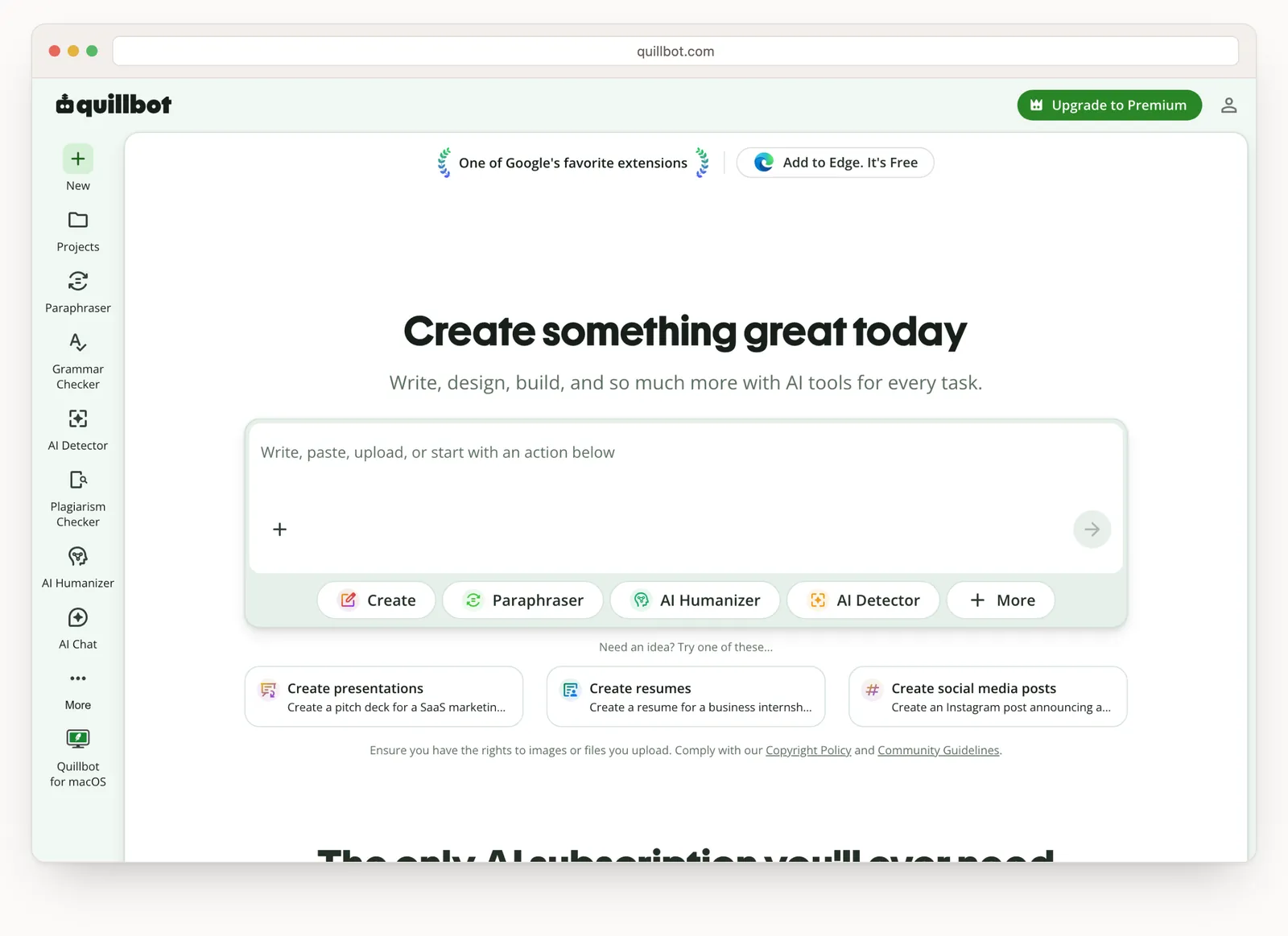
QuillBot: best free
QuillBot is the free option I would actually recommend, not just tolerate.
How accurate is it?
It flagged about 9% of my human sample as AI, which is close enough to clean, and caught roughly 93% of the AI text. That is more than enough for a quick gut check before you publish.
Will it flag your real writing?
Mostly no, though it is less sure-footed than the paid leaders. Short passages and heavily edited hybrid drafts give it more trouble, so I would not lean on it alone for anything high stakes.
What does it cost?
QuillBot is free up to 1,200 words per check. Premium is around $8 a month for unlimited scans, and it sits within the same tool many people already use for paraphrasing and grammar.
Who it's best for
Anyone who wants a capable free check, or a second opinion to sanity-test a paid tool. As a no-cost first pass, it is the free detector worth keeping open.
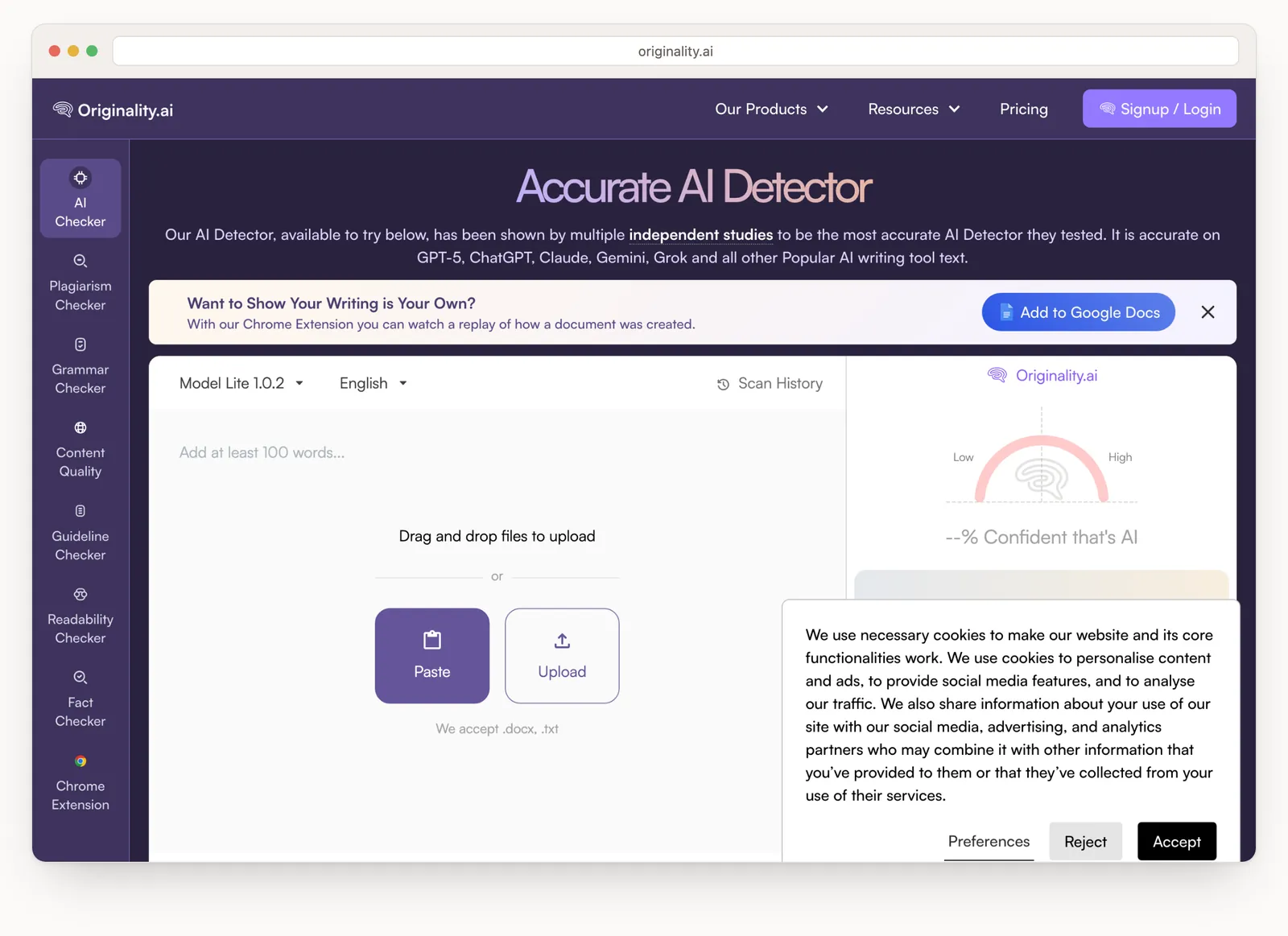
Originality.ai: powerful, but aggressive
Originality.ai is powerful, and that is exactly the problem.
How well does it catch AI?
Very well. It nailed the AI sample at 100% AI with zero hesitation, which is what its fans love about it.
Will it flag your real writing?
Yes, and this is the catch. It looked at a blog post I wrote myself, years before any of this existed, and called it 68% AI. That is the tool confidently telling you a real person faked their own work, and for a publisher or a manager, that score can start a conversation nobody should have to have.
What does it cost?
Originality Plans run $12.95 a month, or a one-time pay-as-you-go pack.
Who it's best for
High-volume AI screening where catching everything matters more than the occasional false accusation, and where a human reviews the results. If fairness matters as much as detection, while its eagerness to see AI everywhere makes it hard to trust.
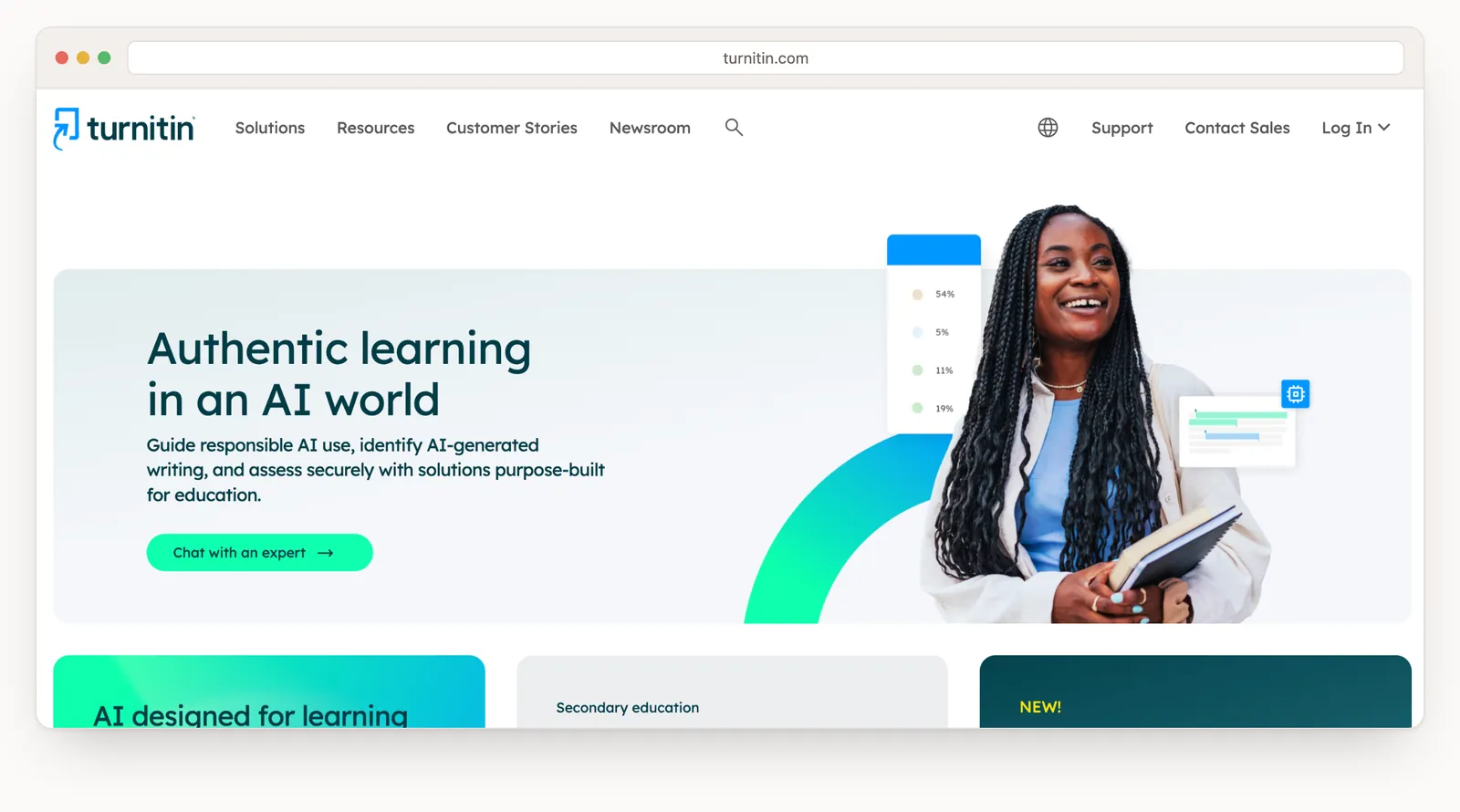
Turnitin: institutional only
Turnitin deserves a mention precisely because you probably cannot test it yourself.
Can you even use it?
Not directly. It is sold to schools and built into their systems, not offered as a tool you can paste text into, so I could not run my samples through it the way I did the others.
Should you trust its score?
Cautiously, if at all. Turnitin sits behind many academic decisions while staying a black box to the students it judges, and it is at the center of the reliability backlash. Vanderbilt turned off its AI detector over the risk of wrongly accusing students.
What does it cost?
There is no consumer price. Access comes through an institution or a learning system.
Who it's best for
Really, only the schools already running it. If that is you, treat the AI score as one weak signal, not a verdict. And if you are a student, know the tool judging you is one several major universities chose to switch off, so ask for a human review.
ZeroGPT: quick free check
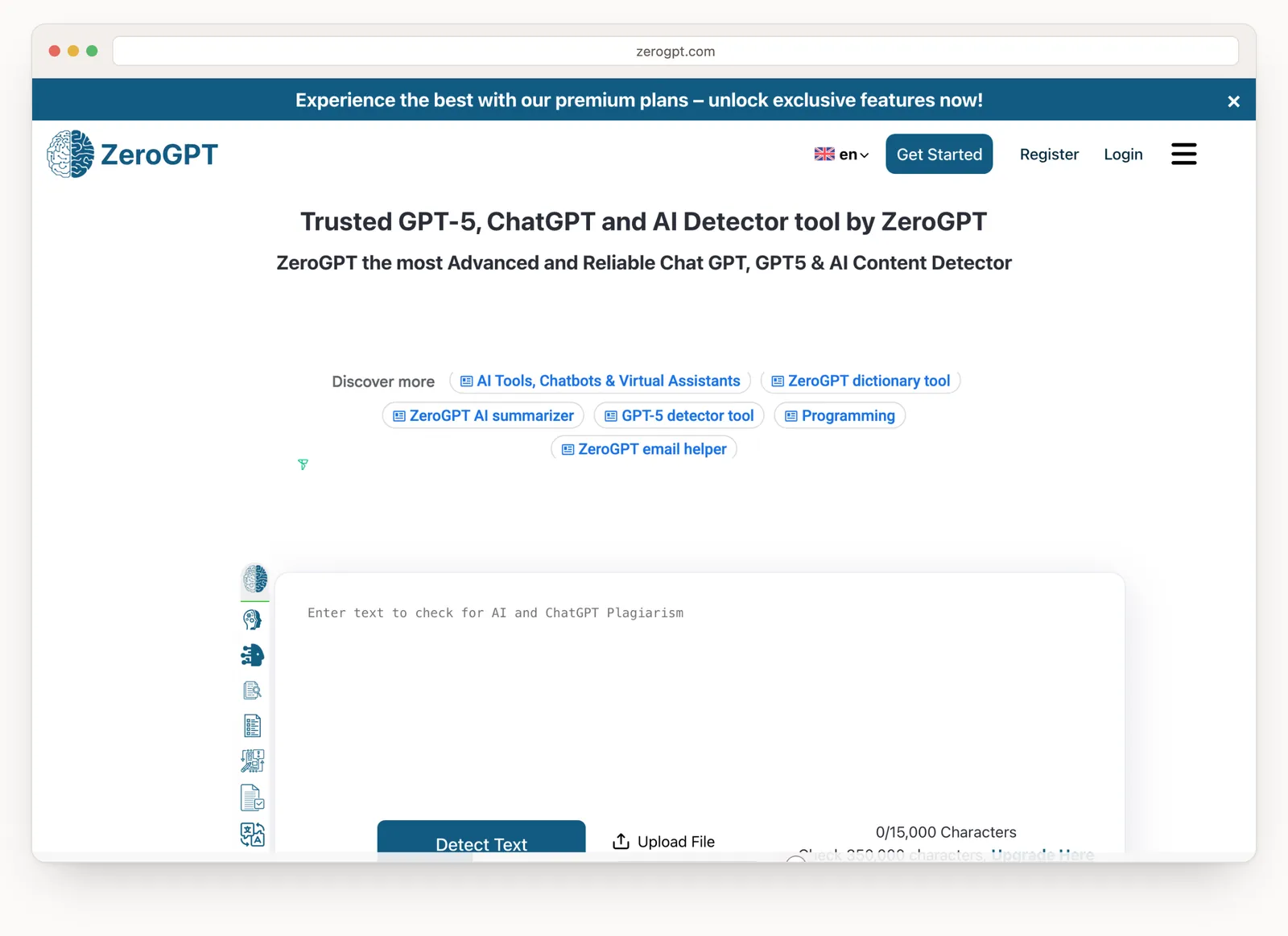
ZeroGPT is the one you will find first, because it is free, fast, and everywhere.
How accurate is it?
Middling. It rated my human sample at 31% AI and the AI sample at 58% AI. It noticed the machine text was more suspicious, but it never drew a clear line between the two.
Will it flag your real writing?
Sometimes, and that is the weakness. When the honest writing scores 31% and the fake scores 58%, you are left with a vague sense that one is more AI-ish than the other. It’s not an answer you can act on.
What does it cost?
ZeroGPT’s core tool is free, with paid tiers available if you want more.
Who it's best for
Casual, low-stakes checks, and only as a second opinion. It does show sentence highlights so you can see what it reacted to, but use it alongside a stronger tool, never as the one that makes the call.
| If you are… | Use | Why |
|---|---|---|
| Teachers & educators | GPTZero | Cautious by design and built for academia, so it is less likely to wrongly accuse a real student. |
| Students | GPTZero · QuillBot | Check your own work before submitting; the free tiers cover most needs. |
| Writers & editors | Pangram · Copyleaks | Accurate on real writing, low false-positive risk, sentence-level detail. |
| Agencies & publishers | Copyleaks | Adds plagiarism checking and LMS workflows for reviewing outside work. |
| Content & SEO teams | Pangram + focus on quality | Detectors do not drive rankings. Use one as a signal and invest in E-E-A-T. |
| A quick free check | QuillBot · ZeroGPT | Fine for a gut check; never the sole judge on anything high-stakes. |
How do AI detectors actually work?
Here is the part most reviews skip, and it is the part that explains every false positive you have ever seen. You do not need a computer science degree to follow it, and even understanding the basics changes how much weight you give to a score.
A detector is not reading your mind or checking a record of who typed what. It looks at the shape of your words and makes a statistical guess. Everything else follows from that.
Do they actually know if your text is AI?
No. A detector does not know who wrote anything. It estimates a probability and then dresses that guess up as a confident percentage.
Once you understand that, the scores stop looking like verdicts and start looking like what they are, which is educated guesses.
What are they actually measuring?
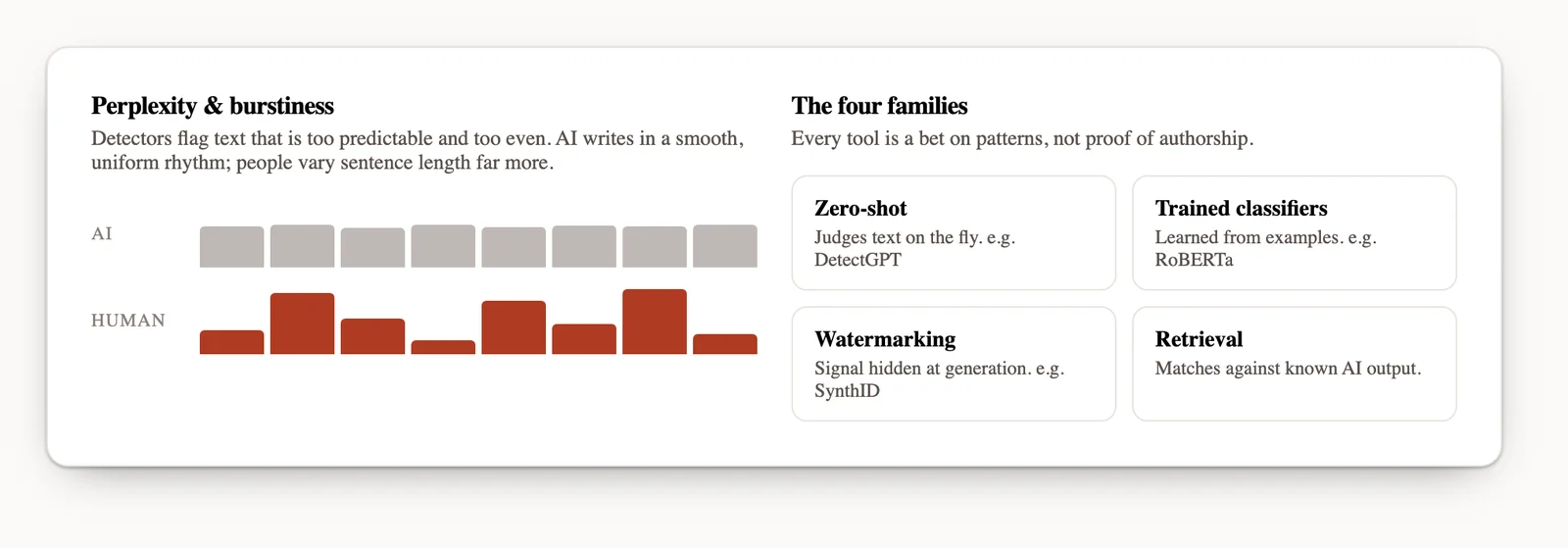
Mostly two things. The first is perplexity, which is just how predictable your word choices are. AI tends to pick the safe, expected next word, so its writing scores as low perplexity, and detectors read low perplexity as machine.
The catch is that clean, simple, or non-native writing is also predictable, which is exactly why real people get flagged. The second measure is burstiness, meaning how much your sentence lengths and rhythms vary. People write in bursts — a long sentence, then a short one, then a rambling one, while AI stays smooth and even.
What are the different types of detectors?
Some are zero-shot methods like DetectGPT that judge text on the fly without being trained on labeled examples. Most commercial tools are trained classifiers, usually built on a language model like RoBERTa that has been trained on thousands of human and AI samples.
A newer approach is watermarking, where the AI hides a statistical fingerprint as it writes, which is how Google's SynthID works. And a few simply compare your text against a database of known AI output.
Why this matters for your score
None of these methods see the truth. They see patterns and place a bet. That is why the same tool can be right about obvious AI and wrong about your own careful writing, and why you should read any score as a probability, not proof.
How accurate are AI detectors, really?
Accuracy is the most misleading number in this entire category, and the tools lean on it because it sells. Every detector wants to wave a big percentage at you, but that single figure hides the trade-off that actually decides whether you can trust it.
Before you believe any accuracy claim, it helps to know what the number leaves out, how wrong these tools can get, and which figure deserves your attention instead.
What does "accuracy" even mean?
Less than you would hope. A detector has two separate jobs — catching AI, and leaving human writing alone. A tool can score 99% accurate by nailing the first job while quietly failing the second, and that failure is the one that hurts you.
Can an AI detector just be wrong?
Yes, badly. OpenAI built its own AI text detector, then quietly shut it down in 2023 because it caught only about 26% of AI text. The company that made ChatGPT could not reliably detect ChatGPT, and it walked away rather than keep a broken tool online.
How big is the false-positive problem?
Big enough that universities have pulled the plug. When Vanderbilt turned off Turnitin's AI detector, it did the math out loud: even a 1% false-positive rate, spread across its roughly 75,000 yearly submissions, would wrongly flag about 750 students.
A number that sounds tiny becomes thousands of real people once you apply it at scale.
So which number should you actually trust?
The false-positive rate on genuine human writing. A good detector proves it can catch AI while keeping false accusations near zero. And no, not just that it scores high on a marketing page. That is the column I read first, and it is the one that determined my rankings at the beginning of the review.
Why do AI detectors flag human writing?
If a detector has ever flagged something you know you wrote, you already feel how unsettling this is. It is also one of the most important things to understand about these tools, because the reason it happens is not a random glitch — it’s built into how they work.
Once you see why honest writing trips the alarm, the goal shifts from writing less like a robot to knowing when to push back. Don’t take it personally because the cause is more mechanical than how AI detectors work.
What makes real writing look "AI"?
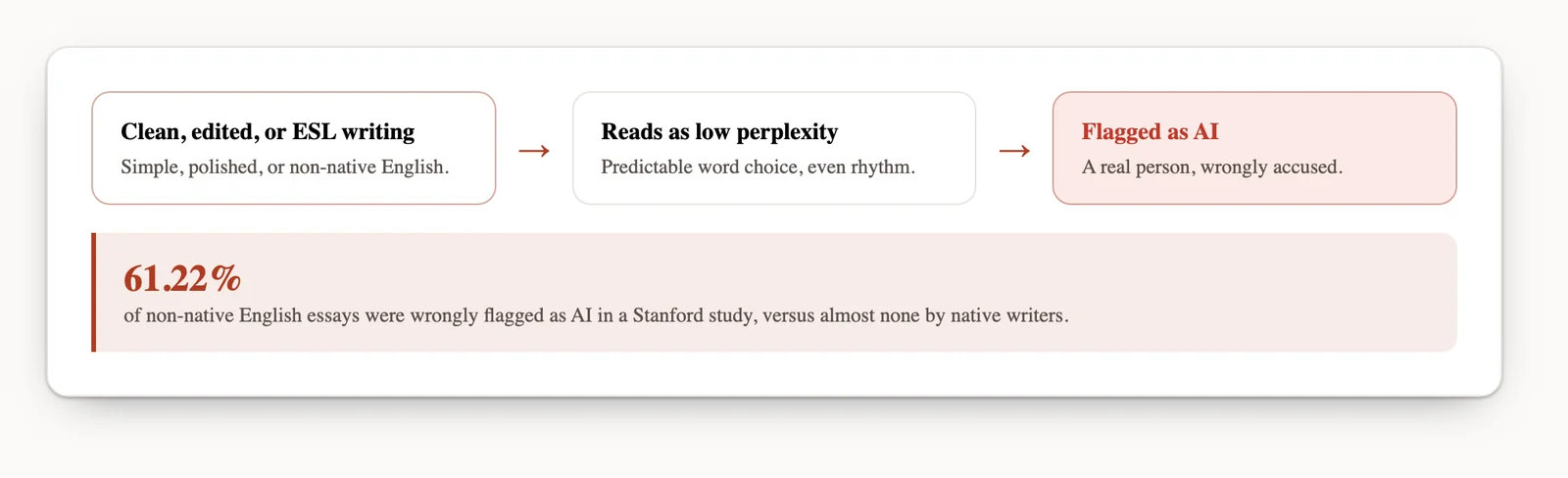
Low perplexity is one factor. Detectors flag predictable text, and plenty of human writing is predictable. It’s simple, clear, heavily edited, or formulaic.
Polish is another factor that can read as machine, so if you run your work through a grammar tool and tighten every sentence, you can nudge it straight into the danger zone.
Who gets wrongly flagged the most?
Non-native English speakers, by a wide margin. A Stanford study found detectors flagged 61.22% of essays by non-native writers as AI, compared with about 5% for essays by native writers. Simpler vocabulary and steadier sentence patterns read as low perplexity, and the tools punish it.
Does a flag mean you did something wrong?
No. It means your writing happens to share surface features with AI text, nothing more. The cleaner and more careful you are, the more likely it can happen, which is a strange and unfair thing to have to worry about, but a real one.
Can you beat an AI detector?
Yes, and more easily than the tools would like to admit. This matters even if you never plan to try it, because it cuts both ways.
If a detector is simple to fool, then a clean score does not prove your writing is human, and a flagged score does not prove it is fake. The same weakness that lets a cheater slip through is the reason an honest writer gets caught in the crossfire.
How easily can you fool one?
Very easily. Paraphrasing tools and humanizers exist for exactly this purpose. Researchers at the University of Maryland and Harvard showed that recursively paraphrasing AI text dropped one watermark detector's catch rate from 99.3% to 9.7%, with barely any hit to quality.
Is watermarking going to fix it?
Not yet. Watermarking hides a signal in AI text as it is generated, and Google's SynthID does this for its own models. But it only works if the AI cooperates and the text is not heavily rewritten, and it does nothing for the mountain of content already published.
Where are AI detectors heading?
Toward discovering content origins rather than detection. Rather than guessing after the fact, standards like C2PA and content credentials aim to record where a piece of content came from at the moment it is made. That is a more honest approach than reverse-engineering a guess, but it is early.
What this means for you
Detection is a game the detectors are slowly losing. Anyone determined to pass can pass, which means a clean score does not prove much and a flagged score is not a conviction. Treat both as soft signals, not the truth.
Do AI detectors affect your SEO and GEO?
This is the question that keeps marketers up at night, and the answer is calmer than the panic suggests. Two kinds of visibility are on the line. One is your SEO, your ranking in Google's classic results, and GEO, short for generative engine optimization, which is whether AI answer engines cite you.
The common fear is that if your content trips an AI detector, Google buries it and AI tools ignore it, so teams burn hours trying to lower a score. That fear is a myth, and it helps to separate it from what actually decides where you show up.
Does Google penalize AI content?
No, not for being AI. Google's own guidance says using AI is fine when it produces genuinely helpful content. What it does penalize is scaled content abuse, meaning mass-produced thin pages built to game rankings.
When Google cracked down in its March 2024 update, it deindexed over 1,400 sites, and a study found every one of them showed signs of AI-generated content. Its 2026 updates kept targeting the same scaled AI content. The tool was never the problem. The thinness was.
Do you need to pass an AI detector to rank?
No. Google does not run your page through GPTZero or Originality.ai before ranking it. There is no AI-score field in its systems, so chasing a low detector number to please Google is effort spent on a gate that does not exist.
What about GEO and AI search like ChatGPT?
The same rule holds for generative engine optimization, and it matters more every month. GEO is about getting cited by AI answer engines like ChatGPT, Perplexity, and Google's AI Overviews, and none of them rank you by a detector score. They pull from content that is easy to retrieve, clearly structured, and well-sourced, then quote it inside their answers.
There is a real irony in that. The same AI people worry is writing their content is now the thing summarizing the web.
And it rewards exactly the qualities a detector cannot measure. Looking human to a detector does not make you quotable to an AI.
So what actually earns you visibility?
Creating content based on Google’s E-E-A-T guidelines, which stands for experience, expertise, authoritativeness, and trust. It’s content with real usefulness, real sourcing, and a point of view worth reading. That is harder to fake than a detector score, and it is what wins in both Google and AI answers.
Producing content at that level, consistently and at scale, is where a human editing pass earns its keep, which is the service I offer.
How to use AI detectors responsibly (and what to do if you're wrongly flagged)
By now the theme is clear. These tools are useful, but they are not judges, and treating a score like a verdict is how people get hurt.
Whether you are checking your own work or someone else's, a little process protects you from the tool's mistakes. And if you have already been flagged for something you actually wrote, you have more options than you might think.
How should you actually use one?
If you must use one, never rest a decision on a single tool. Run your text through two or three, and treat agreement between them as a far stronger signal than any one score. Read the sentence-level highlights instead of the headline percentage, since that is where a tool shows its reasoning.
And keep your drafts, edits, and version history as you work, because that trail is worth more than any detector's opinion.
What if you're wrongly flagged?
Do not panic, and do not accept the score as final. Re-run the text through other tools to show the disagreement, then present your process evidence, the drafts and revision history that prove how the piece came together.
Ask for a human review rather than an automated verdict, and if you need backup, point to the public evidence. The makers of these tools and major universities have both walked away from AI detection over its unreliability.
The honest fix
If the real problem is that your AI-assisted draft reads robotic, a humanizer only games the score for a while. The durable fix is a genuine edit that makes the writing yours, one that holds up whether a detector is watching or not.
Human editing of AI articles is the real fix
You have just seen the whole problem laid out. Detectors are unreliable, easy to beat, and quick to flag the wrong people, and even a perfect score would not make your content accurate or good.
They point at the problem. They never fix it. That is the work I do as a freelance content specialist. I proofread, edit, fact-check, and humanize AI-assisted content so it holds up and is built to rank and get cited.
Article Refresh: fact-checked, humanized, and properly sourced
Your draft is mostly there, but it sounds like AI, and you cannot be sure the facts hold up. An Article Refresh checks every claim and number and corrects anything wrong or outdated using the right source.
Then the Article Refresh proofreads grammar and clarity, so the piece reads as if you wrote it, with your voice and structure preserved.
You get your refreshed article with real citations in any style you choose. It starts at $59 for up to 1,500 words.
Deep Revamp: rebuilt to rank and get cited
When a light edit is not enough, a Deep Revamp does everything in the Refresh, then rebuilds the piece to compete. I retune the headers and structure for SEO and AI search (GEO and AIEO), add new sections and keywords from your direction or my own analysis, and hand back a publish-ready version.
It is the work that turns a flagged draft into a sourced and search-ready page that Google and AI answer engines want to quote. It starts at $149 for up to 3,000 words.
What to choose?
If your content mainly needs to be fact-checked, sourced, and humanized, start with an Article Refresh. If it also needs to rank, get cited, and outclass the competition, go with a Deep Revamp. Editing at volume? There is a five-article bundle and monthly retainers.
Either way, you fix the cause instead of gaming a score, and you end up with accurate, human, GEO- and SEO-ready writing. See the options here.
Which AI detector should you choose?
So which detector should you use? If you have to pick one, Pangram was the most accurate in my testing, with Copyleaks close behind and QuillBot the best free option, but none of them earned real trust.
The bigger lesson matters more than the pick. A detector is a checkpoint, not a verdict. It guesses, it gets things wrong, and it flags real people, so never let a score make a call on its own.
Judge your writing by whether it is genuinely useful and human, because that is what earns trust, ranks in search, and gets cited by AI. Get that right, and the detector stops being something to fear.
That is where I come in. As a freelancer with over 10 years of experience running SEO content for brands, I make your content accurate, reliable, and worthy for search engines and AI to reference. Explore my Editing AI Content service today to see how it works.
Frequently asked questions
Quick answers to the questions that come up most about AI detectors.
What is the most accurate AI detector?
In my testing, Pangram was the most accurate overall, but most accurate is not the same as reliable. It still misses edited or humanized AI and can be gamed, so treat even the best score as a signal, not proof.
What is the best free AI detector?
QuillBot is the free tool I would trust for a real check, up to 1,200 words at a time. ZeroGPT works for a fast casual look, but it is too vague to rely on alone.
Can AI detectors be wrong?
Yes, in both directions. They flag genuine human writing as AI, and they miss AI that has been edited or paraphrased. Read any result as a probability, never as proof.
Can AI detectors catch paraphrased or humanized text?
Usually not. Running AI text through a paraphraser or humanizer strips out the patterns detectors look for, and most tools lose the trail after a rewrite or two.
Does Google penalize AI content?
No. Google penalizes thin mass-produced content, not AI itself. Helpful, well-sourced writing performs regardless of how it was made, in both search and AI answers.
How do I get my AI content to pass detectors?
You do not beat them by tricking them. Humanizer tools only work until the next model update, and they do nothing for your accuracy or rankings. The reliable way is to make the writing genuinely human and well-sourced, which is exactly what my AI article editing service handles.
What should I do if an AI detector flags my writing?
Do not treat it as a final verdict. Re-run the text through other tools, gather your drafts and version history as proof, and ask for a human review instead of trusting an automated score.