


Answer Engine Optimization (AEO)
Answer Engine Optimization (AEO) is the work of writing and structuring your content so AI tools like ChatGPT, Google's AI Overviews, and Perplexity quote it as the answer to a question. SEO gets you ranked. AEO gets you cited. It sits inside GEO, the wider job of showing up across AI search.
A few years ago, a good ranking meant a good click. Someone searched, saw your link near the top, and came to your site. That trade is quietly falling apart.
Now people ask ChatGPT, or they read the AI answer sitting above Google's normal results. They get what they came for and never click anything.
If your traffic has slipped while your rankings held, this is usually the reason. The fix is not to abandon SEO. It is to make sure that when an AI engine writes the answer, your content is the source it pulls from.
This guide covers what AEO is, how it differs from SEO and GEO, how answer engines actually choose what to quote, and the concrete steps to get cited.
What is AEO?
Answer Engine Optimization is how you get your content cited by AI answer engines instead of just ranked on a results page. An answer engine is any tool that reads a question and writes back a direct answer.
ChatGPT does it. So do Perplexity, Google's AI Overviews, Microsoft Copilot, and Gemini. AEO is the work of making your content the thing those tools quote when they build that answer.
What does that look like in practice?
Ask ChatGPT which AI detector is most accurate, and it will name a few tools and, in many setups, cite the articles it pulled those claims from. If your review is one of the cited sources, you win the visibility even though nobody clicked a search result.
If it is not, you are invisible in that answer no matter how well the page ranks. AEO is the work of being one of those cited sources.
What is actually changing in search?
The shift underneath is worth sitting with. Classic search hands you ten links and lets you choose, whereas an answer engine reads the sources itself, decides what is true, and hands back one answer with a couple of citations.
You are no longer competing for a click on a list. You are competing to be the source inside the answer. That is a different job, and most sites are not built for it yet.
What does AEO stand for?
AEO stands for Answer Engine Optimization. You will sometimes see it treated as the answer-focused sibling of GEO, generative engine optimization. The short version is that AEO is about being quoted in the answer, and GEO is the broader picture around it, which the next section makes clear.
How is AEO different from just ranking on Google?
Ranking is about position on a page. AEO is about being the source inside an answer. A page can sit at position three and still get quoted by the AI summary above position one.
It can also rank beautifully and never get mentioned in a single AI answer. Those two outcomes have almost nothing to do with each other, which is exactly why AEO needs its own attention rather than getting folded into your normal SEO checklist.
AEO vs SEO vs GEO: what's the difference?
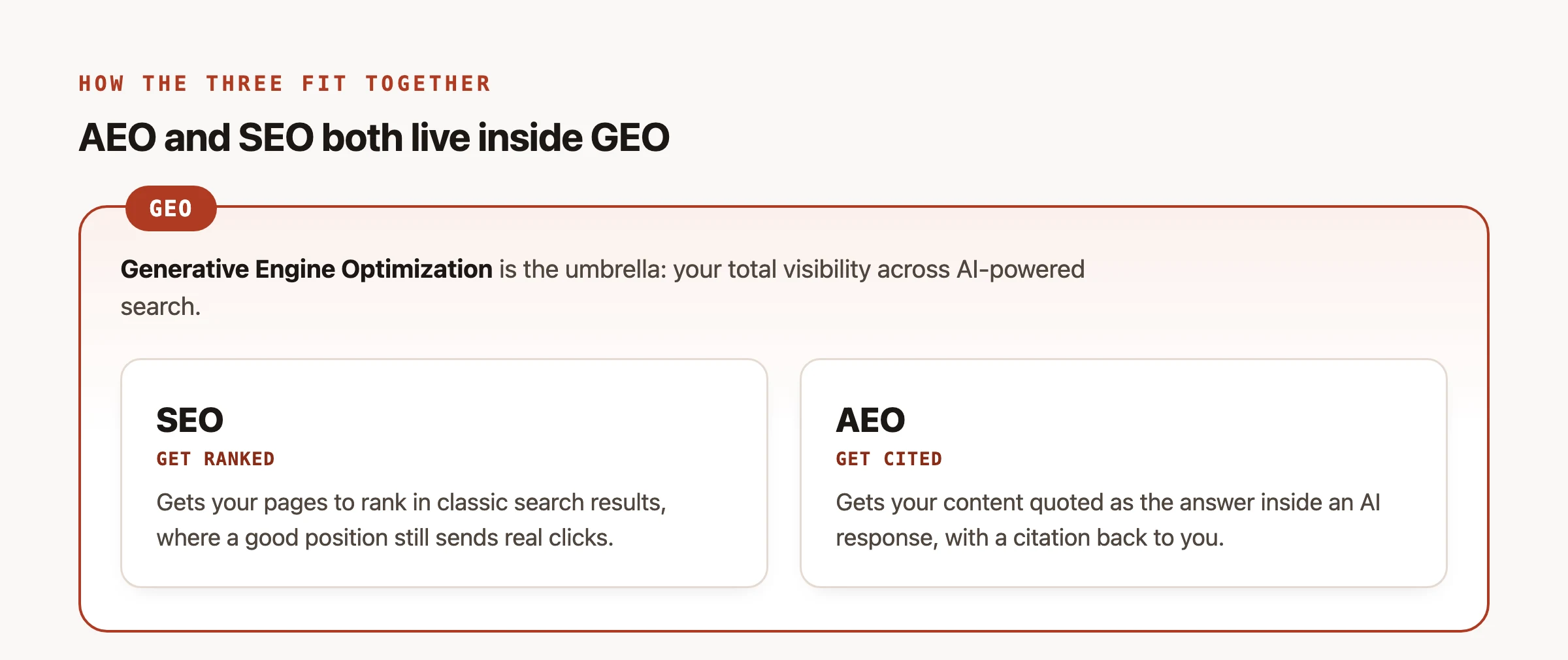
SEO gets your pages to rank in search results. AEO gets your content cited as the answer inside an AI response. GEO, generative engine optimization, is the umbrella over both.
GEO is your total visibility across AI-powered search. So AEO is not a rival to SEO, and it is not the same thing as GEO. AEO is one specific piece of GEO, the piece aimed at winning the cited answer.
These three terms get blended together constantly, and that blur is the real problem. Most guides explain AEO against SEO and stop there, which leaves GEO floating and readers more confused than when they started.
| SEO | AEO | GEO | |
|---|---|---|---|
| What it does | Ranks your pages in search results | Gets your content cited as the answer | Your total visibility across AI search |
| The goal | Position on the page | Be the source inside the answer | Show up wherever AI answers |
| Measured by | Rankings and clicks | Citations and mentions | Overall AI presence |
| Where you appear | Google results list | Inside the AI answer | Across every AI engine |
AEO is one slice of GEO. You want all three working together, not one instead of another.
Which one should you focus on?
Which should you focus on? All three (SEO, GEO, AEO) overlap, and good work on one tends to help the others. A well-structured, authoritative page ranks better for SEO and gets cited more often for AEO.
The practical move is to keep doing SEO, because rankings still send real traffic, and add AEO on top so you also show up when the answer is written for the user instead of listed for them. You will hear this shift called SEO to AEO, but the label matters less than doing both.
What's the difference between AEO and SEO?
SEO measures success in rankings and clicks. AEO measures it in citations and mentions. You want both, but do not assume a page that ranks will automatically get quoted.
Getting quoted takes a specific kind of writing and editing, which the rest of this guide covers.
What is GEO, and how does it fit in?
Treat GEO as the parent term. It covers everything you do to appear in AI search, and AEO is the slice of that work focused on being the answer the engine cites. If someone tells you to do GEO, a large part of what they mean, in practice, is AEO.
How do AI answer engines decide what to cite?
Before you optimize for something for AEO or GEO, it helps to know how an AI engine works. Most answer engines run a process called retrieval-augmented generation, or RAG, and it moves in four steps.
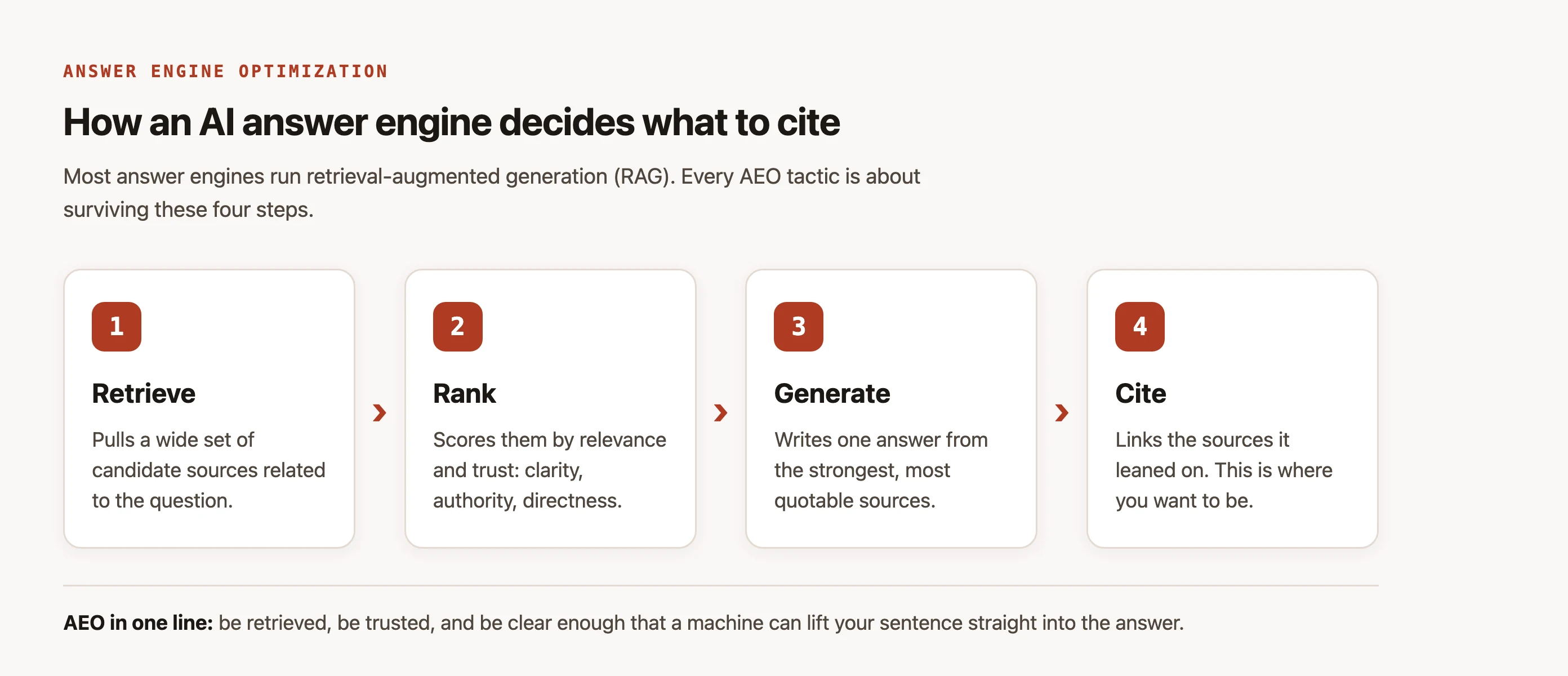
What are the four steps an AI answer engine follows?
Here's how an AI engine stores data and retrieves an answer for users.
- Retrieve. It pulls a set of candidate sources related to the question, usually far more than it will end up using.
- Rank. It ranks those candidates by how relevant and trustworthy they look, leaning on signals like clarity, authority, and how directly the content answers the query.
- Generate. It writes an answer from the strongest sources, stitching together the parts it trusts most.
- Cite. It cites the sources it leaned on so the user can check them.
Every AEO tactic worth doing maps back to surviving those four steps. You want to be retrieved, which means being crawlable and on-topic. You want to be ranked as trustworthy, which means real authority and clean structure.
And you want to be clear enough that a machine can lift one of your sentences straight into its answer without rewriting it. Content that makes the engine work hard to extract a point tends to lose to content that hands the point over cleanly.
Which sources do AI engines cite most?
They lean on places they already trust to be structured and reliable. Wikipedia shows up constantly. So do Reddit threads, YouTube, established review sites, and industry databases.
The practical lesson is that your own website is not the only domain that matters. Being present and accurate where the engines already look, from a well-kept Reddit answer to an up-to-date profile on an industry database, is part of getting cited even when the domain is not yours.
One 2026 study of AI citations found Reddit and Wikipedia are the most-cited sources across the major engines, with YouTube close behind.
Earning that presence is not complicated, just deliberate. Answer real questions in the subreddits your audience actually uses. Keep any industry-database or directory profile current and accurate.
Publish the kind of clear, well-sourced explainer that a Wikipedia editor or a journalist would be comfortable linking to. You are not gaming anything. You are being genuinely useful in the places the engines already read, which is the most durable way to keep getting cited.
How to do AEO: a practical checklist
This is where most AEO guides go vague. They tell you to write answer-first content and leave you there. Let me show you what that actually means, with examples you can copy.
How do you write answer-first content?
Answer-first means the answer comes before the throat clearing. Compare two openings to the question, how long does AEO take?
Buried
"AEO is an exciting and evolving field, and the timeline really depends on many factors unique to your business and industry, so it is hard to say..."
Answer-first
"Most sites start seeing AI citations within two to three months once their content is restructured and the engines re-crawl it. Here is what moves that timeline."
The second version can be lifted straight into an AI answer. The first cannot, because the actual answer is buried under warm-up words that a machine will skip right over. Lead every section with the answer in one clear sentence, then spend the rest of the section supporting and expanding it.
Do the Inverted Pyramid
A good test is to read only your first sentence under each header and ask whether a stranger would already have the answer.
This is the old inverted-pyramid idea from journalism, and it works on machines for the same reason it works on a skimming reader. The most important information sits at the top, and everything after it adds detail for the people who want more. An AI answer engine reading for a quick, quotable line takes your first sentence and moves on.
A reader who wants depth keeps going. Both are served, and neither one has to dig for the point.
What schema markup helps you get cited?
Schema is a small amount of code that tells engines exactly what your content is, so they do not have to guess. Three schema markup types earn their keep for AEO:
- FAQPage marks up a question-and-answer block.
- HowTo marks up step-by-step instructions.
- Article marks up the piece itself, including who wrote it and when it was updated.
Wrapping your FAQ section in FAQPage schema makes each question and answer machine-readable and trivially easy for an engine to extract, which is often the fastest citation win available on a page you have already written.
In plain terms, a FAQPage block wraps each question and its answer in labeled tags that tell the engine, this is a question, and this is its answer. The engine no longer has to guess where your answer starts and stops. You do not need to hand-code any of it either, because most content platforms and SEO plugins generate the markup for you once you fill in the questions and answers.
The effort is small and the payoff, a section built for extraction, is exactly what AEO rewards. For the exact markup on each type, see Google's structured data documentation.
How do you build topical authority and entity clarity?
Engines cite sources that clearly own a topic. That means covering the subject with real depth rather than one shallow post. A critical way to do this is to link your related pieces to each other so the engine sees a cluster, and to be consistent in the names and terms you use so it can connect you to the right concepts.
If you call it AEO in one post and answer optimization in another and never tie them together, you look like two half-experts instead of one authority.
Pick your terms, use them consistently, and build a small library around the topic you want to be known for. That depth is what search engines mean by E-E-A-T.
Do Technical AEO so AI can read your page
None of this writing matters if the engines cannot crawl and retrieve your page. Two technical AEO checks decide that.
First, do not block AI crawlers in your robots.txt, because bots like GPTBot, PerplexityBot, and ClaudeBot have to be allowed in to read you at all. Second, serve your content as server-rendered HTML, since most AI crawlers do not run JavaScript. A page that assembles itself in the browser can look empty to the AI crawlers.
Does content freshness matter for AI SEO?
Yes, more than it does for classic SEO. When an engine chooses between two similar sources, it leans toward the one updated more recently, because stale pages produce wrong answers.
Keep your best pages current and let the update show with a visible date and a real edit, not a date bump with nothing behind it.
How do you keep sections self-contained?
Answer engines often pull a single section out of context, so each one has to make sense on its own. Do not rely on a point you made three headers ago. Restate the small amount of context a section needs, keep it focused on one question, and end it before it wanders.
Self-contained sections are easier to quote, which is the whole game. If you would rather have all of this done for you, AEO-optimized content is exactly what I build, so your pages are structured to get quoted from the day they go live.
How do you measure AEO?
Here is the part AEO tool companies would rather you paid for. You can track AEO without buying a thing, at least to start.
The catch is that you cannot rank-track an AI answer the way you track a Google position. The same question can return a different answer each time, so there is no fixed rank to watch. What you track instead is how often you get cited across AI engines, which people call your share of voice.
What can you track for free?
Start by testing free tracking by hand. Ask AI engines the questions you want to win and see whether you get mentioned. Keep the exact prompts so you can re-run them later.
Watch your referrals also. In GA4, segment the traffic arriving from Chatgpt.com, Perplexity.ai, and similar domains. You will see AI visits that would otherwise hide inside direct traffic.
Use Google Search Console to spot pages that pick up impressions and may be feeding answers. Set a simple brand-mention alert so you know when you get cited somewhere new.
None of that needs a subscription, and together they tell you what is working in your AEO optimization efforts.
How do you track AI citations without a paid tool?
Keep a short list of your target questions. Run them through two or three engines once a month and log where you show up and where a competitor beats you. It is manual, but it is honest, and the log shows you progress over time.
If you want a head start on cleaning content into answer-ready shape before you test, my AI article editor does that fast.
What paid tools track AEO?
Once you outgrow manual checks, various AI-visibility tools measure your share of voice and citations across ChatGPT, Perplexity, and Google's AI Overviews. Profound is the category leader, and Peec.ai is a lighter, more agency-friendly option. Then you have Otterly, Ahrefs Brand Radar, and Semrush's AI toolkit also in the mix.
Start with the free stack above, and add a paid tool only once your citation volume is worth paying to measure.
Why AEO matters now
Getting cited in AI search is not a someday problem. According to SparkToro's 2026 study, more than two-thirds of Google searches now end without a click, because the answer is often right there on the page with Google AI Overviews.
The overlap between what ranks on Google and what AI engines cite has narrowed sharply. 5W Research reported in 2026 that it fell from around 70% to under 20%, which is the blunt version of the whole problem. You can rank number one and still be missing from an AI answer.
Gartner predicted in 2024 that traditional search volume would fall roughly 25% by 2026 as AI answers absorb it.
And the engines doing the absorbing are enormous. OpenAI reported in February 2026 that ChatGPT alone serves 900 million weekly active users, and it is only one of several.
Earn AI search visibility today
The takeaway is timing. The window to earn AI search visibility as a cited source is open right now, while most of your competitors still optimize only for the click and treat AI answers as somebody else's problem.
The sites that structure for citations early are the ones the engines will keep quoting as this becomes the default way people search.
Want your content AEO and GEO optimized?
Knowing how AEO works and having the time to do it are two different things. If you would rather the citations just start showing up, that is the work I do when editing content.
I build content from the ground up to get ranked and quoted by AI. Whether it is through my Content Refresh or Content Revamp service, I can tune pages so they rank well for SEO and show up in AI answers.
Get Your Content Ranking and Cited in AI Search →
The bottom line
Optimizing for search is shifting from ten links to one answer. AEO is how you make sure that answer includes you. Lead with the answer, structure it so an engine can lift it cleanly, earn real authority on your topic, and check whether you are getting cited.
Do that, and you stop quietly losing the traffic that stopped clicking. And if you would rather not do it alone, that is exactly what I build with my AEO optimization service. See how your brand can get cited in AI answers today.
Frequently asked questions
Is AEO the same as SEO?
AEO and SEO are not the same, but they are under the same umbrella. SEO aims to rank your pages in the results. AEO aims to get your content cited inside AI answers. They overlap and support each other, but you optimize for them differently.
Does AEO replace SEO?
AEO is not replacing SEO, at least at this stage. Ranking still drives real traffic, and it will for a long time. AEO adds a second front, being the answer, on top of ranking. You want both working together rather than choosing one.
How long does AEO take?
In my experience, most sites start seeing citations within two to three months, once the content is restructured and the engines re-crawl it. Established, trusted sites often move faster because the engines already lean on them.
What AEO tools exist?
Paid platforms exist for tracking citations at scale, but you can start with manual prompt testing. Start with Google Analytics and Google Search Console, then add a paid tool later if the volume justifies it.